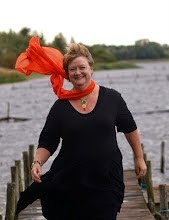
One of the workshop leaders at International symposium for storytelling as a healing art, July 2009, Denmark
 In his first book, Coyote Medicine, Lewis Mehl-Madrona tells his own story—as a medical doctor trained at Stanford University School of Medicine who began rediscovering the healing traditions of his Native American heritage. In the book, he writes, “From a Native American perspective, healing is a spiritual journey … People can get well. But before a person can do so, he or she must often undergo a transformation—of lifestyle, emotions, and spirit.” He is a firm believer that ancient and modern approaches to illness can and should be integrated in a way that offers patients the benefits of both. In this piece, he explores the vital role of story in health and healing.
All of us come from a past in which our ancestors lived in direct relationship with nature and with each other, intricately woven together in communities. People’s lives and the health of the group were sustained by shared knowledge and experiences. Stories were an active part of everyday life. If you asked an elder a question, you got a story in response—that way you would never forget. Stories were used to teach, to bring healing, for enjoyment, as well as for reprimands. We all come from cultures of story.
The notion of story is crucial to identity. “All you are is story. When you pass over, the stories told by you and about you are all that remains,” said one Native American elder. Another said, “We are all the stories that have been or ever will be told about us.” In many indigenous cultures, identity formation is the development of a coherent master story that links together the multitude of one’s told and yet-to-be-told stories into a yarn that makes sequential sense. Psychosis and other mental illnesses are seen to be the result of the breakdown of that coherent narrative, an inability to make narrative sense of one’s self and one’s life.
So how does story relate to healing? In traditional times, when someone got ill, it was the role of the healer in the community to attend to the person’s body, mind, and soul. It was important to communicate with the spirit of the illness to find out what was causing the problem and what could be done to change it. The healer would also intensify the power of the community to help its sick members, often through ceremony and ritual, and would intercede with the spirit world by directly asking for help for the patient.
These traditional healers and elders worked (and still work) through stories. They know that illnesses do not exist in isolation and are not just biological facts. From the moment of the first symptom, the illness becomes an element of our story and the main character in its own story. Bringing these stories into the open in order to understand the energies behind the physical symptoms is an important part of finding solutions that uniquely suit the individual.
This is why I begin much of my healing work with a conversation with the person’s illness, a principal character that can, itself, be interviewed. The illness has a spirit, or soul, if you will, that can be engaged with when we enter a slightly altered state of consciousness. Its communication is usually extremely enlightening, bringing a clarity to the situation that would be hard to attain in any other way. The results of this dialogue provide clues about how to proceed in creating health.
One of my clients, Shannon, came to me because she had diabetes. Now, diabetes is a character that has filled many stories over time and across cultures. But its presentation varies within each individual’s life, and I worked with Shannon to find out what it was doing in her life specifically. When we began, neither of us knew that in order to heal, Shannon would need to address a core story that had been passed down from generation to generation, requiring her to face her deepest beliefs.
In the first session, I had Shannon relax and enter an altered state. When we first set off to converse with Shannon’s diabetes, it was very elusive. We had to go looking for it. Eventually, we found ourselves in a bayou on a flat-bottom boat. We were hunting frogs and dodging alligators. As it turned out, Shannon had an uncle who used to hunt frogs early in the morning, selling them to fancy restaurants just after daybreak. They were the freshest frog legs money could buy. She had gone with him a few times and had helped with the frogging.
Shannon’s diabetes turned out to be a really big frog. We stopped into its lair for a chat, and Shannon apologized for her uncle’s hunting its kin. “Oh, well, he had to eat,” responded the Frog King, “but the joke’s on him. In the end, I ate him.” He was right. Her uncle had lost both of his legs to diabetes; gangrene had literally eaten them off.
“Why are you here?” asked Shannon.
“I came at birth,” he said. “I just wait until the right time to appear. Then I claim you for my own.”
“What if I don’t want to be claimed by you?”
“Well, then,” said the Frog King, wearing an old-time suit like that of a Mississippi River boat gambler, “you’ve got to live your passion. Nothing else will do. You see, I can’t compete with passion. It trumps every card in my deck.”
The dialogue continued productively, but this small vignette highlighted the key message for Shannon: she needed to live her passion. When we explored what this might mean, together we discovered how miserable she was in her job, her relationships, her life. She worked just to make money in an environment that she hated and felt was unethical and demeaning. Her partner mooched off her and rarely held a job. She resented his freeloading.
She kept telling herself that she could be better if only she worked harder, tried harder, and sacrificed more. Together, we got to the core of this idea: it was part of a family story, a story about how God rewards good Catholics who then are celebrated and healed. At a deeper level, Shannon’s mother and grandmother actually had a lot of anger at God for not following the formula.
For Shannon, there was a direct relationship between the beliefs she had inherited with this family story and her diabetes. But in order to heal, she needed to understand more about how to change the story. What did she really believe? We sought further guidance.
In this communication, Shannon was told by a healing spirit, “You’d like to heal. You’re trying to. But what if you can’t? Everyone and everything has limits. And God has no more power than all of us added up, because all of us, together, are God.” This contradicted and challenged Shannon’s story about an omnipotent, omniscient, and omnipresent God. And it led her toward another question and another story, that of how she would live if she were God to herself. Would she be punishing or loving?
Through our work together, Shannon constructed a new story about her life, a story in which she was part of a compassionate God, she could live her passion without fear, and she didn’t have to sacrifice in order to be blessed. As this new story developed, her health improved, and she began to feel stronger. She exercised. She lost weight. She went to ceremonies. The symptoms of her diabetes disappeared, though we knew it still lurked in the corners and the shadows, ready to return if given the opportunity. As Shannon changed her story, other aspects of her health improved. She successfully used herbs to reduce her glucose and her cholesterol. Homeopathy reduced her neuropathic pain. Acupuncture improved her digestive symptoms.
There are many, many stories like this—stories of healing in which a person becomes empowered to create health through a change in their story.
* * * * *
The trilogy of books I’ve written on Native American healing practices are called Coyote Medicine, Coyote Wisdom, and Coyote Healing. Coyote is the teacher who reminds us to be open to everything, including change. He is the clown, the trickster, and the survivor, reminding us to shift perspectives, to be willing not to know, and to laugh at ourselves and our shortcomings. Coyote reminds us that medicine is anything that works.
All of our ancestors, no matter where from or how far back, used stories for healing. Every one of us can draw on this past, however distant and however forgotten. An encoded memory of this ancestral past is embedded within our DNA. All who are alive today carry the wisdom of our ancestors within our genetic code.
As I wrote at the end of one of my books: “If I had to choose one single idea, it would be: Don’t give up. Don’t stop trying. Help is always available, whether inside or out of the halls of conventional medicine. Don’t give up until you’ve tried everything there is to try. Help yourself to a little coyote medicine, and thrive.”
Lewis Mehl-Madrona, MD, PhD, trained in family medicine, psychiatry, and clinical psychology and has been on the faculties of several medical schools. The author of Coyote Medicine, Coyote Healing, and Coyote Wisdom, a trilogy of books on what Native American culture has to offer the modern world, he is of Cherokee and Lakota heritage.